BLOG
How Do You Know When Your Forestry Equipment Needs Service?
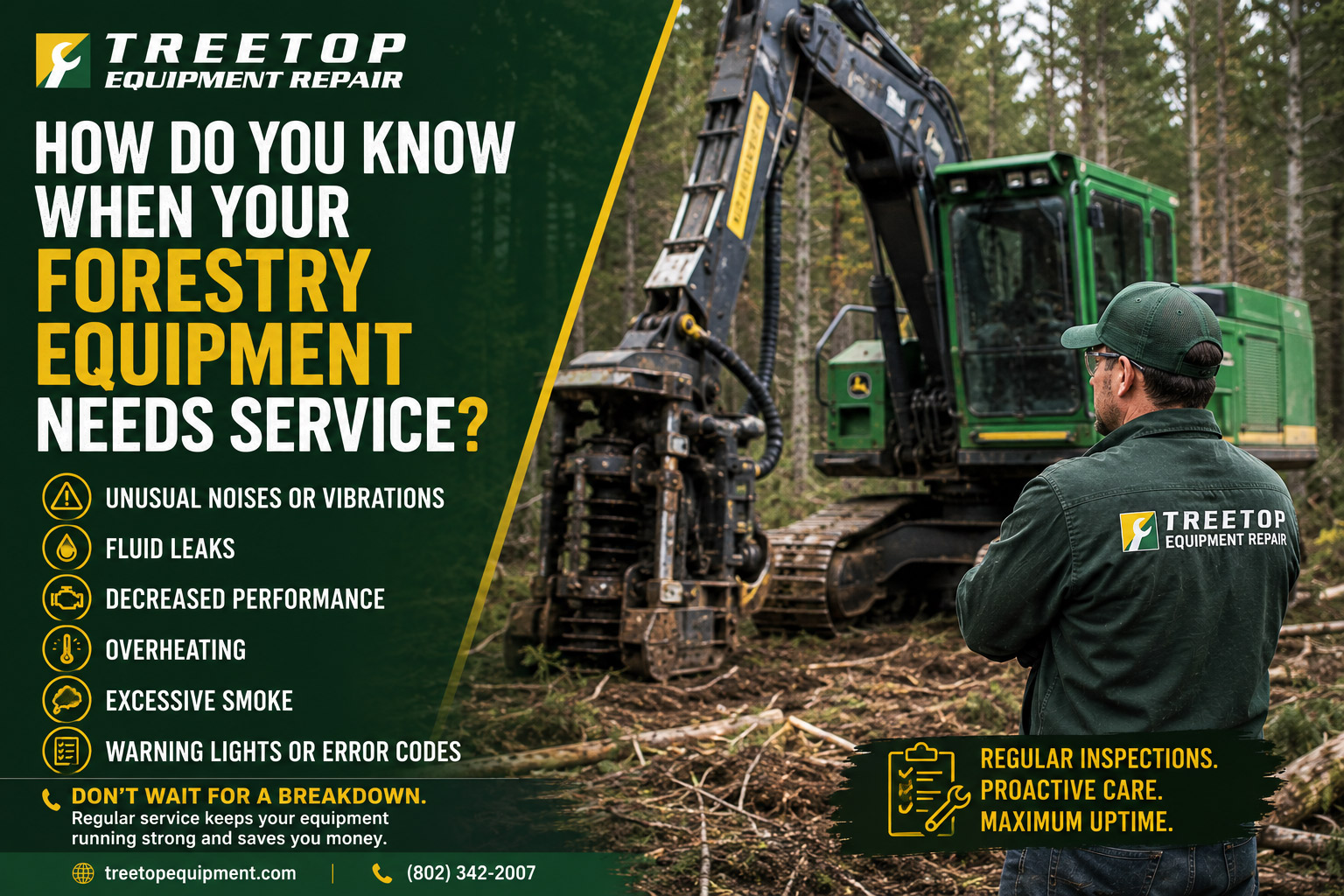
Forestry equipment works in some of the harshest conditions any machine can face. Feller bunchers, skidders, mulchers, harvesters, and forwarders operate in terrain that would stop most other machines cold — steep slopes, mud, debris, extreme cold, and near-constant load cycles that push hydraulic and mechanical systems to their limits. In that environment, problems can develop quickly, and the warning signs are not always obvious. Knowing how to read your equipment and recognize the early indicators of a developing service need is one of the most valuable skills a forestry operator in Vermont can develop.
Performance Changes That Signal a Problem
The most reliable early warning system on any forestry machine is the operator who runs it every day. Small changes in how equipment feels, sounds, or responds often precede measurable failures by hours or days. The following performance shifts deserve immediate attention.
Reduced hydraulic response: If your feller buncher's accumulator cycles more frequently, your skidder's blade moves noticeably slower under load, or you hear increased pump noise during peak demand, hydraulic pressure or flow has likely degraded. This can indicate pump wear, a failing relief valve, internal cylinder bypassing, or fluid contamination.
Longer cycle times on harvesters and forwarders: Experienced operators know exactly how long each cut-and-process cycle should take. When those times begin creeping up without a change in timber size or terrain, mechanical inefficiency is developing somewhere in the system.
Changes in travel behavior on skidders and forwarders: Drifting, uneven braking, or a feeling of resistance in turns can indicate issues with the differential, brakes, or the steering hydraulic circuit. These symptoms warrant a diagnostic before they worsen.
Unusual sounds during operation: New grinding, knocking, squealing, or cavitation noise from the pump or drive components should never be attributed to normal wear and dismissed. Sounds are often the first indication of a developing mechanical failure.
Visible fluid loss or new leaks: Any new oil or hydraulic fluid appearing on the machine or on the ground beneath it after a shift is a signal that needs investigation before the next operating day.
Warning Lights and Diagnostic Codes in Modern Forestry Equipment
Modern forestry equipment from manufacturers like Sennebogen and others is equipped with onboard diagnostic systems that monitor dozens of operating parameters in real time. When a sensor detects a value outside normal range, a warning light or fault code is generated. Many operators dismiss warning lights that are not accompanied by obvious performance issues — but these codes are the machine communicating something before a failure becomes visible.
Common codes in forestry equipment relate to hydraulic temperature, filter restriction, engine coolant temperature, fuel system pressure, and battery or alternator voltage. Any active fault code should be read and interpreted by a qualified technician. In Huntington, Vermont, where a forestry operation can only afford so many non-productive days during the season, acting on a fault code warning early is far preferable to diagnosing the failure it was predicting. A code that disappears on its own should still be investigated — intermittent faults often precede consistent ones.
Fluid Condition and Filter Checks as a Service Indicator
Fluid analysis is one of the most underused diagnostic tools in forestry operations. Both laboratory sampling and visual inspection provide critical information about the condition of your equipment's systems.
Laboratory Fluid Analysis
When hydraulic fluid, engine oil, and gear oil are sampled and sent to a laboratory, the results can detect elevated metal particles indicating abnormal wear, water contamination that compromises lubrication, and oxidation byproducts showing the fluid is breaking down thermally. A fluid analysis program run every 250 to 500 hours gives you a trend line over time — meaning you can see a system deteriorating before it fails, rather than discovering the failure on the landing.
Visual Inspection
Even without lab analysis, looking at fluids and filters tells a story. Hydraulic fluid that has turned dark brown has experienced heat degradation. A milky appearance indicates water contamination. A hydraulic filter with its bypass indicator popped to red means the filter is full and system debris is bypassing filtration entirely. Either condition requires immediate service. Making visual fluid and filter checks part of the daily walk-around takes less than five minutes and catches problems that a machine's onboard sensors may not flag until damage has already begun.
Scheduled Service Intervals for Vermont's Forestry Season
Beyond reactive monitoring, a structured service schedule is the foundation of forestry equipment reliability. Vermont's logging and land-clearing season puts intense hour accumulation on machines in a compressed window, which means service intervals come up fast. The following schedule applies to most forestry equipment, though always defer to your operator's manual for model-specific requirements.
Every 10 operating hours or daily: Check fluid levels, inspect for new leaks, examine cutting components for wear or damage, and assess tire or track condition. This is the minimum baseline for machines running full shifts in Vermont's terrain.
Every 250 hours: Change engine oil and filter, inspect the hydraulic filter, grease all zerk fittings, and inspect cutting head components including chains, bars, and knives for wear beyond manufacturer tolerances.
Every 500 hours: Take a full hydraulic fluid sample for laboratory analysis, check transmission fluid level and condition, inspect boom and arm pins and bushings for wear, and perform a full cooling system check including hose condition and coolant concentration.
Every 1,000 hours: Perform a major service including complete fluid changes across all systems, thorough belt and hose inspection, undercarriage measurement on tracked machines to assess wear against manufacturer wear limits, and a full fuel system service.
Frequently Asked Questions
How often should forestry cutting head components be inspected separately from the machine?
Cutting components — saw chains, bar oil systems, disc blades, and knives on harvesters — should be inspected at every daily or shift check. These components wear rapidly in hardwood timber and can cause secondary damage to the cutting head if allowed to degrade significantly. Most manufacturers recommend chain and blade inspection every shift in production cutting conditions.
What is the most common reason forestry equipment fails prematurely?
Contaminated hydraulic fluid is the leading cause of premature failure in forestry equipment. Debris, water, and heat degradation in the hydraulic system cause accelerated pump and valve wear, seal failures, and cylinder scoring. A disciplined hydraulic fluid maintenance program — including regular sampling, filtration, and complete fluid changes at manufacturer-specified intervals — is the single highest-value maintenance investment in a forestry fleet.
How does Vermont's cold climate affect forestry equipment service requirements?
Cold temperatures thicken hydraulic fluid and engine oil, increasing startup wear on pumps, motors, and engine components. Extended warm-up periods of 10 to 15 minutes at low load before full production are critical in Vermont winters. Cold-weather hydraulic fluid formulations and engine oil with appropriate viscosity ratings for the operating temperature range should be confirmed before each winter season.
Should I track operating hours manually if my machine does not have a working digital hour meter?
Yes. Service intervals tied to hour readings are not approximate guidelines — they are engineering-based maintenance windows that protect expensive components. Losing track of hours means service intervals get missed, which accelerates wear and can void some warranty provisions. A simple paper log kept in the cab is sufficient if the digital meter is not functional.
Can forestry equipment be serviced on the landing rather than transporting it to a shop?
Many routine and intermediate service tasks can be performed at the landing. Fluid changes, filter swaps, greasing, cutting component replacement, and basic diagnostic work are all field-serviceable. Major hydraulic repairs, structural inspections, and any work requiring specialized tooling or a hydraulic press typically need to be done at a service facility with proper equipment.
Conclusion
Your forestry equipment communicates through its performance, its fluids, its sounds, and its diagnostic codes. Learning to act on those signals — rather than waiting for an obvious failure — is the difference between a planned service call and a breakdown in the middle of a timber job. Operators throughout Huntington, Vermont and the surrounding region depend on consistent maintenance to keep machines running through the season. Tree Top Equipment Repair specializes in forestry equipment service and is an authorized Sennebogen service provider, with factory training and genuine parts to keep your equipment operating correctly. Call (802) 598-8375 to schedule a service inspection.

Our Services
Contact Information
Phone:
Address:
113 Maple Ridge Ln, Huntington, VT 05462, United States of America
Helpful Links
Mon - Fri : 7:00AM - 5:00PM
Sat - Sun : Closed