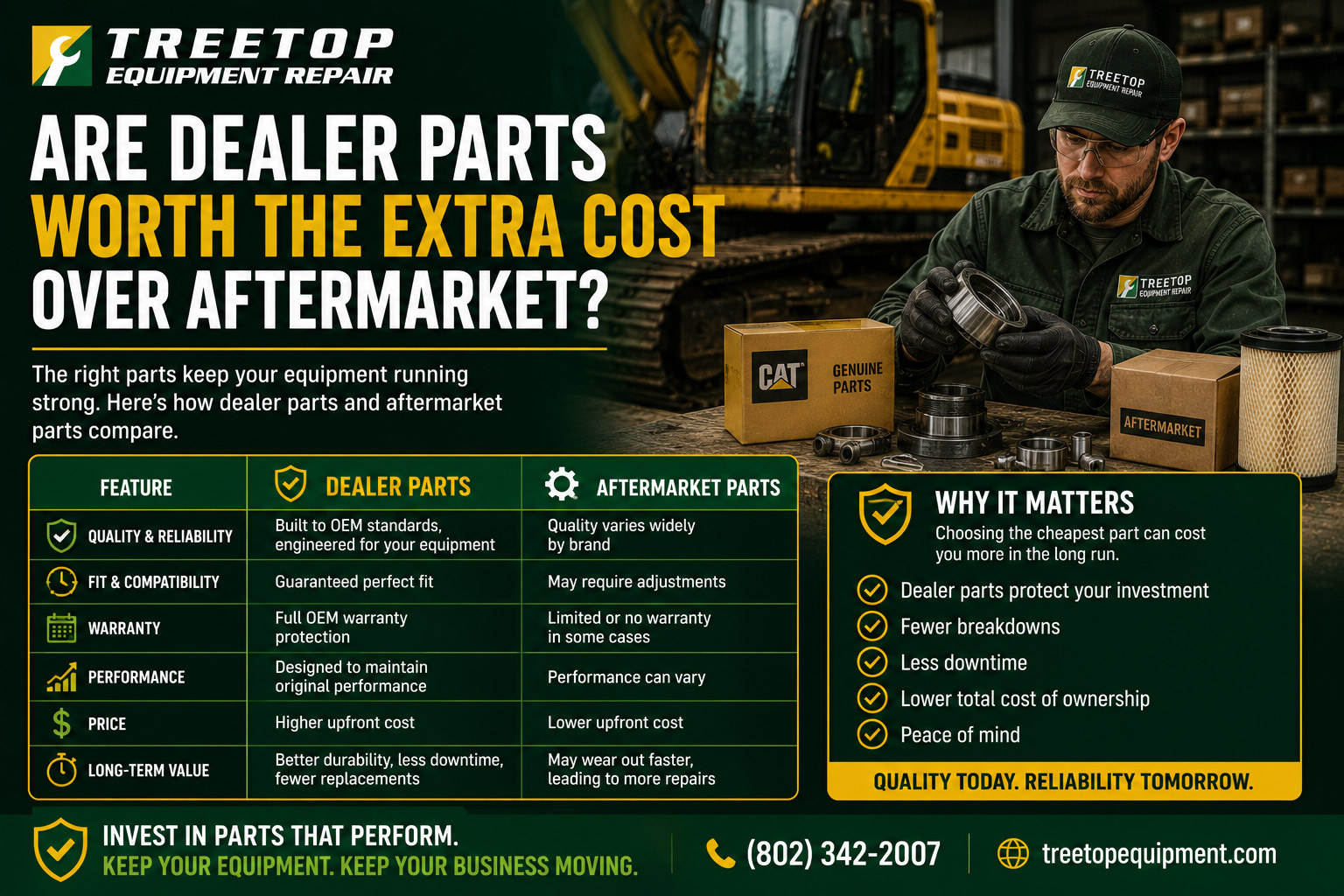
Are Dealer Parts Worth the Extra Cost Over Aftermarket?
It comes up on almost every major repair estimate: the choice between OEM dealer parts and aftermarket alternatives. The dealer part costs $340. The aftermarket version is $95. On the surface, the math seems obvious. But for heavy equipment operating in Vermont's demanding conditions — frozen mornings, muddy terrain, long work cycles — the calculation is more nuanced than a price tag comparison. The quality, fit, and longevity of the parts installed in your machine have downstream effects on labor costs, warranty coverage, and the likelihood of repeat failures. Understanding what you are actually buying in each category is the only way to make this decision intelligently.
What OEM Parts Actually Are — and What They Are Not
OEM stands for original equipment manufacturer. In the heavy equipment world, this means parts produced to the exact specifications used in the original assembly of the machine — the same tolerances, the same materials, the same quality control processes. When you purchase an OEM hydraulic seal kit for a Sennebogen material handler, you are getting a component engineered specifically for the pressure cycles, temperature ranges, and fluid chemistry of that machine's hydraulic system.
What OEM does not always mean is that the part was made by the equipment manufacturer itself. Many OEM components are produced by specialty suppliers under contract. When sourced through the authorized dealer network, they carry manufacturer part numbers, traceability, and warranty coverage tied to the specific machine. This traceability matters for warranty claims and for ensuring the installed part is the one that was engineered for the application — not a visually similar component with different material properties or dimensional tolerances.
The Aftermarket Spectrum: Not All Non-OEM Parts Are Equal
Aftermarket is not a single category — it is a wide spectrum. At the top of that spectrum are Tier 1 aftermarket suppliers who manufacture components to OEM specification or better, with rigorous quality control and documented performance data. These parts often carry their own warranties and are used extensively in fleet maintenance programs where cost management is a priority without sacrificing reliability. Brands like Baldwin, Donaldson, and Fleetguard in the filtration space are examples of aftermarket manufacturers that produce components at or above OEM performance standards.
At the bottom of the spectrum are low-cost import parts with inconsistent manufacturing tolerances, inferior seal materials, and no meaningful warranty backing. The challenge is that both types look identical in a parts catalog and may arrive in similar packaging. Price is often the only visible differentiator — which is exactly why price alone is an unreliable quality indicator in the aftermarket space. A $95 hydraulic pump seal kit from a reputable Tier 1 manufacturer is a fundamentally different product from a $95 kit sourced from an unknown overseas supplier with no quality documentation.
When OEM Parts Are Worth the Premium
Certain applications make the case for OEM parts clearly. These situations share a common thread: the cost of the part failing is disproportionately high relative to the price difference between OEM and aftermarket.
Hydraulic pump seals and internal components: Pump failures are expensive. A seal that fails under high-pressure cycling can cause cavitation damage that destroys the pump body within hours. OEM seals rated for the exact pressure and temperature range of the specific machine eliminate a variable in this risk.
Engine gaskets and head seals: A failed head gasket on a diesel engine is a serious repair. The gasket itself is a small fraction of the total repair cost — the labor to remove and reinstall the head is the major expense. Using a lower-quality gasket to save $40 on a job that costs $2,500 in labor is not a rational trade-off.
Final drive seals and bearings: Final drives on excavators, skidders, and forestry machines operate in contaminated, high-load environments. OEM sealing and bearing specifications are designed for those conditions. Inferior components in this application accelerate wear on surrounding parts that cost far more to replace than the original final drive seal.
Warranty-covered machines: If your machine is under manufacturer warranty, using non-OEM parts in a repair can void coverage. For machines operating under an authorized service agreement — such as Sennebogen warranty service at Tree Top Equipment Repair — OEM parts are a contractual requirement, not a preference.
Critical safety components including brake system parts, structural pins, and load-bearing fasteners, where dimensional accuracy and material strength are non-negotiable and the consequences of component failure go beyond a repair bill.
When Aftermarket Parts Make Practical Sense in Vermont
For equipment operators in Huntington, Vermont, there are legitimate situations where quality aftermarket parts are the practical choice without meaningful quality compromise. Wear items that are replaced frequently — air filters, fuel filters, hydraulic return filters — are well-suited to aftermarket sourcing from established suppliers. These companies produce filters to OEM specification at significantly lower prices, and for high-volume consumables, the savings add up meaningfully across a season without any performance trade-off.
Structural wear components like bucket teeth, cutting edges, and wear plates are also commonly sourced aftermarket without quality concern, provided the supplier is recognized in the industry. The material specifications for ground-engaging components are well-understood, and reputable aftermarket manufacturers produce items that meet or exceed OEM wear ratings. The decision becomes more complex for hydraulic components, electrical parts, and engine internals — which is where the OEM premium tends to deliver measurable value over the life of the repair. A useful working rule: the more labor it takes to install a part, and the more damage a part failure causes to surrounding components, the stronger the case for OEM.
Frequently Asked Questions
How can I tell if an aftermarket part is genuinely high quality before I buy it?
Look for parts from manufacturers with documented quality programs — ISO 9001 certification is a meaningful baseline. Ask the supplier for the warranty terms on the specific part and what their return and failure policy is. Reputable aftermarket manufacturers stand behind their products with clear warranty terms, not just a return window tied to the purchase date.
Does using aftermarket parts affect my ability to make a warranty claim on the machine?
In the United States, the Magnuson-Moss Warranty Act generally prohibits manufacturers from voiding a warranty solely because aftermarket parts were used — unless the manufacturer can demonstrate that the aftermarket part caused the failure. However, for equipment operating under specific factory service agreements, the terms may be more restrictive. Always review your warranty documentation before making this decision.
Are remanufactured parts a good middle ground between OEM and aftermarket?
Remanufactured parts — such as reman hydraulic pumps, starters, and alternators — can be an excellent middle ground. Quality reman components are disassembled, inspected, rebuilt to OEM specification with new wear parts, and tested before sale. They often carry warranties comparable to new OEM parts at significantly lower cost. The key is sourcing from a recognized reman supplier with a documented rebuild process.
What should I ask my technician when they recommend a specific part source?
Ask which manufacturer or brand the part comes from, what the warranty coverage is on that specific part, and whether the technician would use the same part on their own equipment. A technician confident in their parts recommendation will answer these questions directly. Hesitation on any of these points is worth noting before you authorize the repair.
Can I supply my own parts and bring them to a shop for installation?
Some shops will accept customer-supplied parts, but most will not warranty the labor if a customer-supplied part fails. If you source your own parts, understand that the shop's warranty covers their labor only — not the outcome if the part proves defective. For complex repairs where a warranty on the result matters, allowing the shop to source parts is generally the more protected position.
Conclusion
The OEM versus aftermarket decision is not a blanket choice — it is a component-by-component evaluation based on the application, the quality tier of the available aftermarket option, and the cost of failure if the part does not perform. For high-stress components in hydraulic, engine, and drivetrain systems, OEM parts typically deliver a better total cost of ownership even at a higher upfront price. For routine wear items from established suppliers, quality aftermarket options are a legitimate and cost-effective choice. Tree Top Equipment Repair in Huntington, Vermont carries genuine parts for the brands it represents — including Rotobec, Sennebogen, and Blue Diamond Attachments — and provides transparent guidance on parts selection for every repair. Call (802) 598-8375 to discuss your equipment's specific needs.
